Purpose-built logistics AI — deployed department by department across Culina's five operating clusters. Domain intelligence, governance-first architecture, and a diagnostic-led engagement model.
Culina Group operates across five distinct clusters — each with different systems, operational profiles, and AI applicability. The right AI deployment sequences by cluster, not group-wide.
The AI layer that actually moves the needle is one that understands how logistics businesses run — not one that has to be taught.
Generic AI tooling that requires your team to define every workflow, train every model, and stitch every integration — with no logistics knowledge built in.
Purpose-built logistics agents that arrive with domain knowledge, pre-integrated connectors, and proven KPIs — so you deploy to outcomes, not experiments.
AgentFleet mirrors your organisational structure. Every department gets its own team of agents — a supervisor that manages the workflow, and task agents that execute. Humans stay in control through explicit approval gates and real-time dashboards.
One unified AI platform spanning all clusters and departments. Governed by a shared policy layer, with full audit trail and HITL controls.
Each department has a dedicated team of agents scoped to its workflows, data access, and KPIs.
Supervisor agents manage workflows end-to-end — delegating to task agents, monitoring outputs, and escalating to humans when thresholds are breached.
Specialised agents that perform discrete tasks — each governed by an explicit policy, with defined permissible actions and approval requirements.
| Cluster | Companies | Control Tower | Driver Management | Carrier Management | Settlements | Customer Experience |
|---|---|---|---|---|---|---|
FMCG Ambient |
Great Bear · MMi Distribution · Culina Logistics · Warrens |
Staging Congestion · Multi-Leg Visibility
|
Dock Slot Sequencing · Departure Adherence
|
Slot Confirmation · SLA Re-Tender
|
4-Way Match · Invoice Freeze
|
Proactive ETA Push · Failure Patterns
|
Cold Chain & Fresh |
Fowler Welch · Eddie Stobart |
Appointment Monitor · Inbound Forecast
|
Dock Slot Sequencing · Temp Excursion Alert
|
Pre-Arrival Alert · Exception Claim
|
||
Palletised Network |
TPN (56 depots, 5,500+ hauliers) |
Inbound Forecast · Scan Audit
|
No-Show Detection · KYC Compliance
|
ETA Notification · WISMO Resolution
|
||
E-Commerce & Returns |
iForce |
Priority Dispatch · Returns Classification
|
Pre-Delivery Call · POD Quality Check
|
Outbound Slot · Reliability Monitor
|
Claims Adjudication · Automated Settlement
|
WISMO Resolution · Post-Miss Recovery
|
Specialised & European |
IPS · Stobart Europe · IRF · CML |
Port Clearance · Cross-Border Visibility
|
Fatigue Detection · HOS Compliance
|
CO₂ Tracking · Trial Lane Gating
|
Detention Billing · Ad-Hoc Charges
|
ETA Communication · NPS Escalation
|
We don't deploy across every department on day one. We pick the highest-value workflow, build it end-to-end with full policy governance and integration, prove the ROI — then scale iteratively across your BUs and departments.
Governance Principles
Culina will be pitched by horizontal AI platforms and consulting firms. Neither can compete on the six dimensions below — not because Shipsy builds faster, but because a decade of logistics deployments creates compounding advantages that can't be replicated from scratch.
Every agent decision visible, auditable, and approvable in real time. No desktop bottleneck — supervisors approve, override, or escalate from any device.
Seven layers — from system of record to full observability. Each layer is purpose-built for logistics, not adapted from a generic AI stack.
Agent identifies a driver wants a callback in 30 min → follow-up created with time tracking → auto-triggers at the right time, considering time zone, preferred channel (call/WhatsApp), and no-answer escalation logic.
Map systems, volumes, business KPIs, and user workload
Surface manual tasks across planning, execution, finance, and customer service
Prioritise repetitive, high-effort, high-impact processes suitable for AI agents
Estimate labour hours saved, SLA improvements, cost avoidance, and efficiency gains
Select relevant Shipsy agents and workflow packs; define policies and guardrails
Model savings vs. implementation cost, ROI timeline, payback period
Present opportunities, expected outcomes, and phased rollout plan (Pilot → Scale → Autonomy)
A Forward-Deployed Engineer embedded at Culina — not a remote integration project. Same-day turnaround on rule changes.
Enterprise control over every node — autonomous by default, auditable at every step. Start from a pre-built logistics agent or build from scratch.
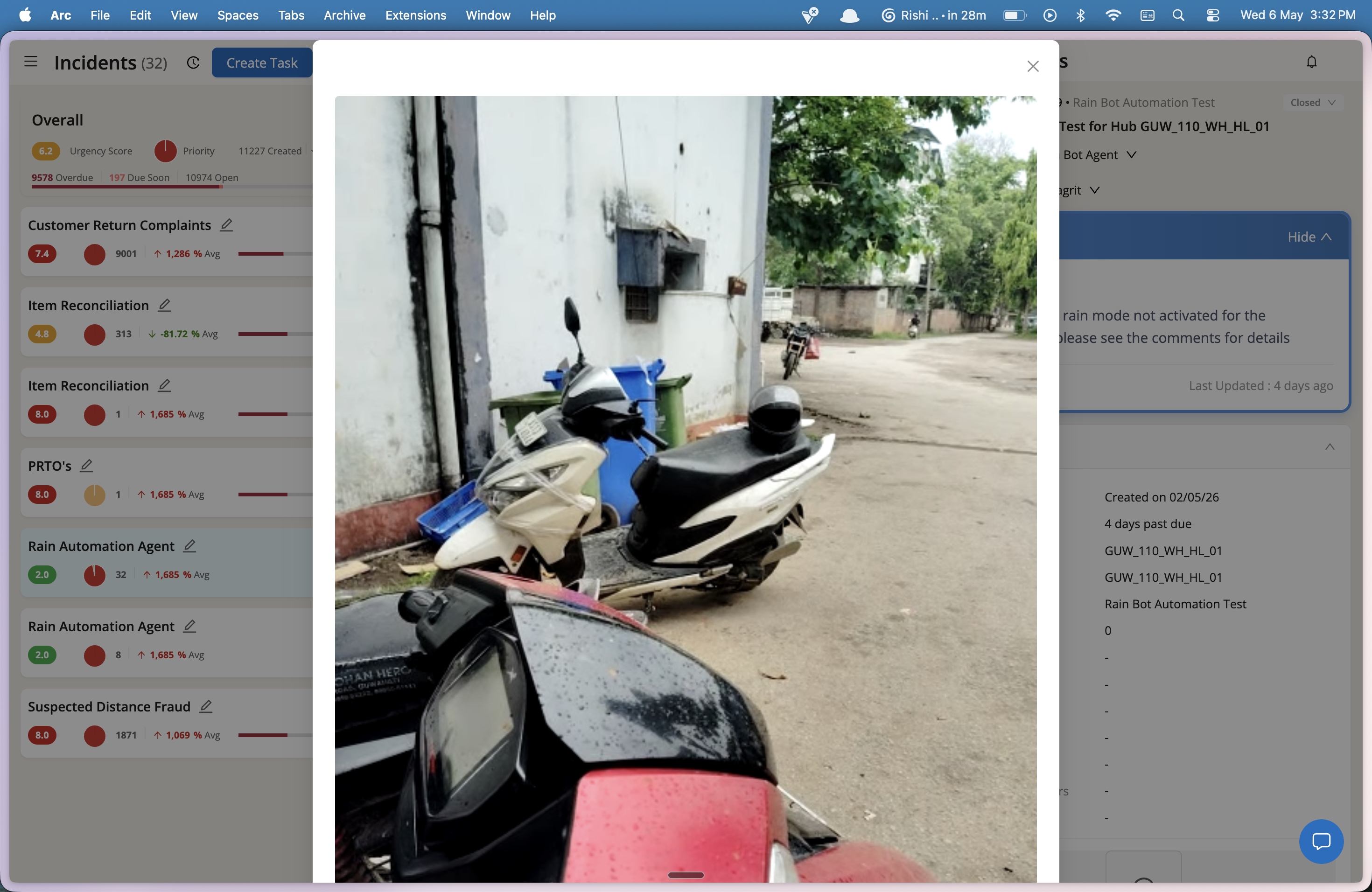
Start from a pre-built logistics agent — RainBot, QC Inspector, Follow-Up Agent — or build from scratch.
Assign to specific depots, regions, or BUs. One config, redeployable across Great Bear, TPN, Fowler Welch.
Pick from a logistics tool library — Control Tower, Carrier API, POD ingestion, telephony trigger, and more.
Add retry, follow-up, eval, and HITL policies. Define confidence thresholds — explicit rules, not opaque behaviour.
Paste any SOP or prompt. Agent grounds decisions against Culina's procedures — not generic best guesses.
Shipsy AI doesn't replace your existing systems. It sits as a System of Action above your Systems of Record — connecting to every BU's stack, normalising data, and executing decisions in real time. Two paths, one outcome.
For BUs adopting Shipsy TMS/WMS as the system of record. Native integration — no connectors, no latency, no data mapping overhead.
For BUs retaining existing systems — Paragon, SAP TM, Oracle TM, Blue Yonder, Manhattan. No migration required.
Shipsy's AI platform is grounded in a logistics-specific data lake, knowledge graph, and integration library built over a decade — so every agent arrives with domain context that generic AI platforms take years to develop.
Embedded at Culina's site. Understand the baseline — map systems, volumes, KPIs, user workload. Surface friction points. Spot agentable workflows. Quantify value. No 6-month discovery engagement.
Agent architecture blueprint, integration design, and a CFO-ready business case: savings vs. implementation cost, ROI timeline, payback period. Present to CXOs with phased rollout plan.
One workflow. One BU. Fully governed. First agent in production in weeks, not quarters. Measurable value in months. Then expand iteratively across Culina's clusters — no reinvention, same blueprint.
Let's book the workshop and begin building the blueprint for Culina's AI transformation.